Our Combat Divisions
The men of O’Neill’s Regiment carried the tools of both precision and power, each reflecting their discipline, heritage, and valour. The muskets of the infantry, French-pattern flintlocks paired with steel bayonets, formed the backbone of the regiment, enabling coordinated volleys that could turn the tide of battle. Officers and sergeants bore elegant small swords, engraved with Irish symbols and mottos, while veteran soldiers carried short hangers for close combat — all instruments of leadership and courage. Supporting the line, the regiment’s artillery detachment operated light field guns with skill and precision, delivering thunderous fire that bolstered French forces across Europe. Together, these weapons were more than instruments of war; they were symbols of the regiment’s enduring loyalty, the unbroken spirit of the Irish Brigade, and the proud legacy of the O’Neill name.
The Combat Divisions of O'Neill's Regiment
Click on each link to find out more!
Musket
Weapons and Pride of O’Neill’s Regiment
Like many European armies of the 16th and 17th centuries, O’Neill’s Regiment carried the standard weapons of their time. The exact arms they used often depended on where they fought and who they fought alongside.
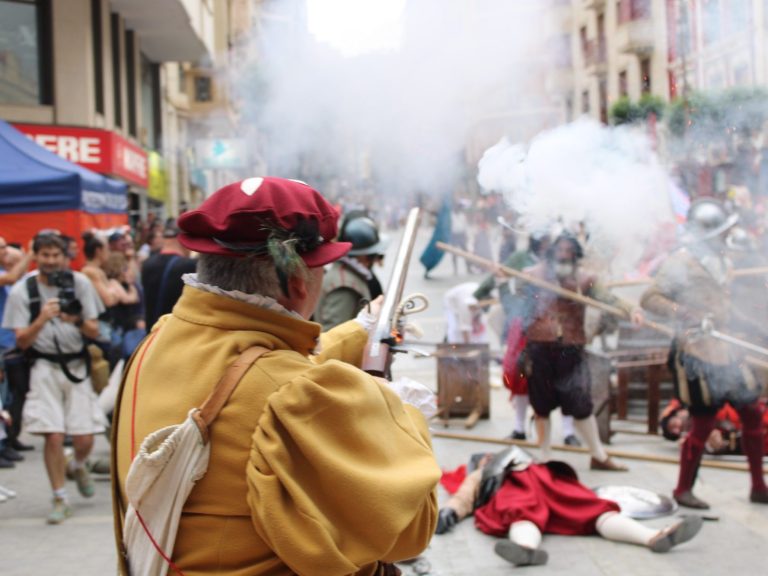
Serving mainly as a Spanish regiment (Tercio), O’Neill’s men were usually armed with the Spanish musket or harquebus, most of which were matchlocks in the early 1600s. As warfare evolved, these gave way to the more reliable flintlock muskets.
When Irish soldiers returned home to fight in the War of the Three Kingdoms (1641–1653), their weapons came from many sources — Spain, Scotland, and the battlefield itself. Later, during the Williamite War (1689–1691), the regiment first used English muskets, then received French flintlocks brought into Limerick in 1691.
Though their clothing was often plain, the men of O’Neill’s Regiment took great pride in their weapons. Their muskets were always clean and polished, unlike many other armies who darkened their barrels with chemicals. Every shining musket spoke of discipline and pride in their craft.
For O’Neill’s soldiers, the musket was more than a tool of war — it was a symbol of honour, loyalty, and identity. Just as swords and axes once defined the warrior, the musket came to represent the steadfast Irish soldier — the saighdiúir.
Their regimental motto captured this spirit perfectly:
“Fir na Dílseachta” — Men of Loyalty.
Artillery
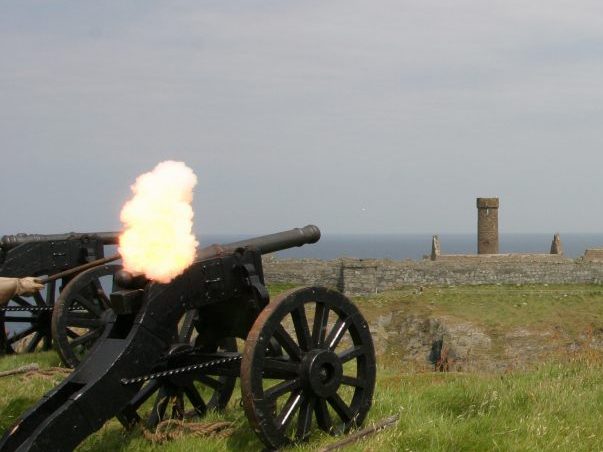
Though primarily an infantry regiment, O’Neill’s maintained a small but formidable artillery detachment, formed in the early 17th century to provide direct fire support during siege and field operations. Drawn from men skilled in metalwork and engineering — often Irish artisans who had followed the regiment into exile — this unit operated light 3- and 4-pounder field guns supplied by the French arsenal. Their service was invaluable during campaigns in Flanders and Italy, where rapid deployment and precision fire could turn the tide of battle. The artillerymen wore the regiment’s scarlet coats with black facings and green trim, distinguishing them from the line companies, and bore the same motto: “Fír na Dílseachta” — “Men of Loyalty.” Known for their discipline and technical skill, the gunners of O’Neill’s Regiment earned the respect of both their comrades and their French counterparts, ensuring that the thunder of Irish cannon was heard wherever the regiment marched.
Even today, our artillery unit commands respect and honour wherever it performs with some of the best and loudest weaponry in re-enactment today.
Sword and Rondell
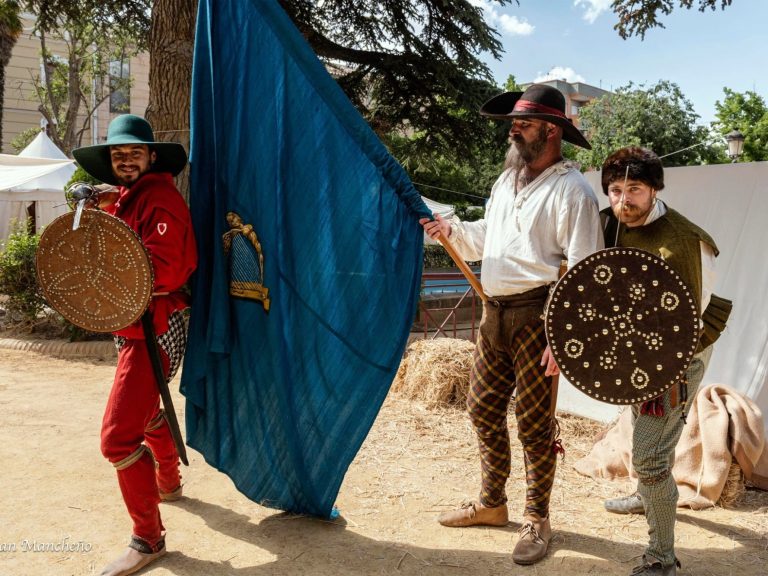
The sword of O’Neill’s Regiment was more than a weapon — it was a symbol of heritage, loyalty, and command. Officers and sergeants carried elegant small swords of French manufacture, featuring slender blades suited to both duelling and battlefield leadership. Their hilts were often of gilded brass or polished steel, engraved with the Red Hand of Ulster or the harp and crown of Ireland, and wrapped in black ray-skin bound with twisted wire. Many blades bore inscriptions in Latin or Irish, such as “Pro Fide et Patria” (“For Faith and Fatherland”), a quiet testament to their cause. Among the rank and file, the short hanger or sabre was the mark of a trusted veteran — practical for close combat and heavy enough to meet cavalry in the press of battle. Passed from one generation to the next, these swords embodied the spirit of the regiment: the courage of exile, the pride of service, and the unbroken steel of Irish resolve
Pike
The Pike in O’Neill’s Regiment
Before the musket became the soldier’s main weapon, the pike was at the heart of every European army — and O’Neill’s Regiment was no exception.
A pike was a long spear, often over 15 feet in length, used in tight formations to defend against cavalry and to protect the musketeers as they reloaded. In battle, pikemen stood shoulder to shoulder, their weapons forming a solid wall of steel — a sight both impressive and terrifying.
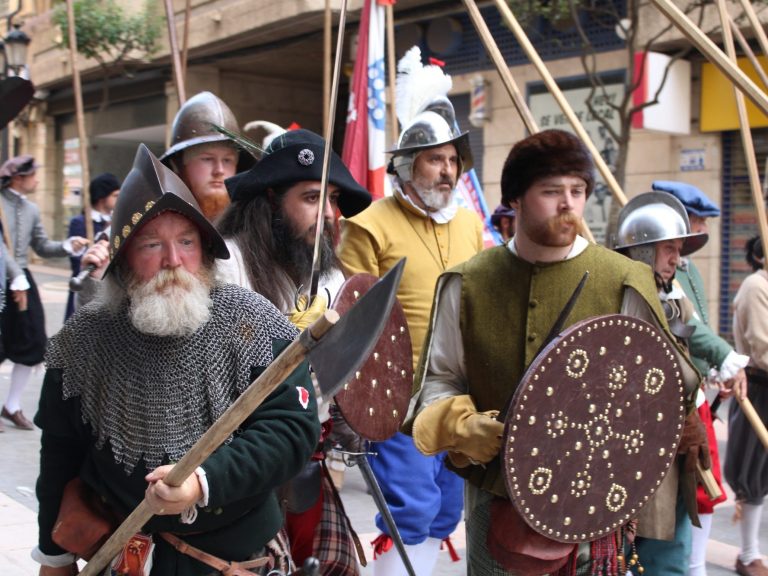
When O’Neill’s Regiment served under Spanish command as part of a Tercio, the classic mix of pike and shot was their main tactic. Pikemen provided the strength and discipline at the centre of the formation, while musketeers delivered firepower from the flanks.
As firearms improved through the 17th century, the need for pikes gradually declined, and by the late 1600s, they were largely replaced by bayonets fixed to muskets. Still, the spirit of the pikeman — his steadfast courage and unity in the face of the enemy — remained central to O’Neill’s tradition.
For the men of the regiment, the pike represented discipline, endurance, and loyalty — the same values later carried on by their musket-bearing comrades.